
| Perennial Toothache Plant |

|
 |

|


| File size | 369030 |
| Original date | 1/28/22 11:23 AM |
| Resolution | 1400 x 1050 |
| Flash | Flash did not fire, auto |
| Focal length | 4.7mm |
| Exposure time | 1/663s |
| Aperture | 1.8 |
| Focus Distance | |
| Metering Mode | Center weighted average |
| Camera make | Xiaomi |
| Camera model | Redmi Note 10 Lite |
| Sensor type | MonochromeArea |
 |
 ative ative |
 |
 |
 |
Photo: |
Botanical name: Acmella calva Family: Asteraceae (Sunflower family)
Synonyms: Spilanthes calva, Spilanthes acmella var. calva
Synonyms: Spilanthes calva, Spilanthes acmella var. calva
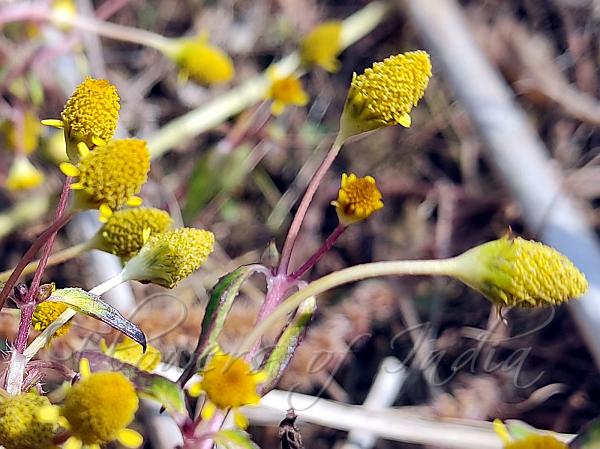
Perennial Toothache Plant is a perennial herb with
stems creeping or prostrate, 20-60 cm, hairless, rooting at nodes,
sparsely hairy. Leaf-stalks are 5-8 mm, velvet-hairy; leaf blade
lanceshaped, 3-7 x 1-3 cm, below nearly hairless or only velvet-hairy
along veins, above velvet-hairy, base wedge-shaped, margin peaked
sawtoothed, tip tapering or with a tail. Flower-heads are
ovoid-conical, 9-11 x 6-8 mm, carried on stalks 3-14 cm. Flower-heads
are yellow; ray florets female, about 4 mm, blade short, obovate, tip
shallowly 3-lobed; disk florets bisexual, tubular, about 2 mm, 4- or
5-toothed. phyllaries about 8, 2-seriate, nearly equal, green,
ovate-oblong, 3-3.5 mm, margin fringed with hairs, tip pointed or
blunt; receptacle columnar-conical, 4-8 mm; paleae oblong, boat-shaped,
membranous. Achenes are brown, oblong, 1.5-2 mm, velvet-hairy or
hairless. Perennial Toothache Plant is found on streamsides, marshes,
moist forest margins, fields, at altitudes of 1000-1900 m, in Yunnan,
India, Indonesia, Myanmar, Nepal, Philippines, Sri Lanka, Thailand.
Flowering: All year.
Medicinal uses: Two to three flower-heads are
crushed and mixed in a spoon with honey taken twice a day for 2-3 days,
to cure dry cough, in folk medicine in Maharashtra. Flower-heads are
also used for curing toothache.
Two to three flower-heads are
crushed and mixed in a spoon with honey taken twice a day for 2-3 days,
to cure dry cough, in folk medicine in Maharashtra. Flower-heads are
also used for curing toothache.
Medicinal uses:
Two to three flower-heads are
crushed and mixed in a spoon with honey taken twice a day for 2-3 days,
to cure dry cough, in folk medicine in Maharashtra. Flower-heads are
also used for curing toothache. | Identification credit: Tabish | Photographed in Imphal, Manipur. |
• Is this flower misidentified? If yes,