
| Nepali Cinnamon |

|
 |

|


| File size | 1444561 |
| Original date | 4/16/25 1:36 PM |
| Resolution | 2048 x 1536 |
| Flash | Flash fired, return detected, red-eye reduction |
| Focal length | 60.0mm |
| Exposure time | 1/200s |
| Aperture | 14.0 |
| Focus Distance | |
| Metering Mode | Center weighted average |
| Camera make | NIKON CORPORATION |
| Camera model | NIKON D7000 |
| Sensor type | OneChipColorArea |
 |
 ative ative |
 |
 |
 |
Photo: |
Botanical name: Cinnamomum glaucescens Family: Lauraceae (Laurel family)
Synonyms: Cecidodaphne glaucescens
Synonyms: Cecidodaphne glaucescens
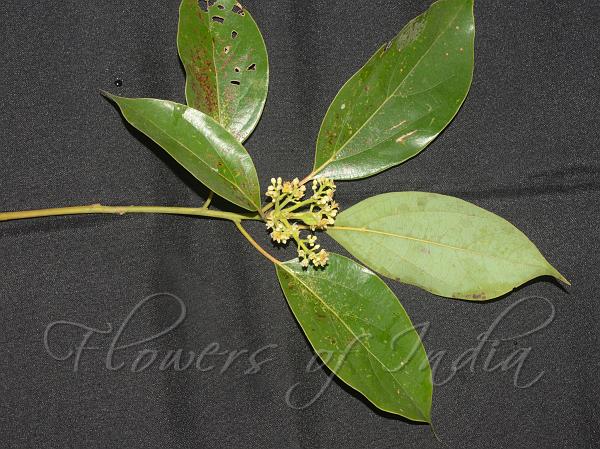
Nepali Cinnamon is an evergreen tree growing around 15
m tall, and is highly valued for its fragrant bark. It has leathery,
elliptical, or ovate leaves, 2-10 cm wide, 5-18 cm long. The tree is
well-known for its aromatic leaves, which, when crushed or bruised,
release a pleasing cinnamon scent. Its primary distinguishing
characteristic is its unique scent, which also helps set it apart from
the other plants. The undersides of the leaves may seem paler than the
glossy, dark green color on upper surface. Overall, the foliage appears
sleeker because of the smoothness of the margins. There are noticeable
veins that run parallel to the midrib in pinnate veins. The flowers are
small and barely noticeable, grouped into panicles. They are
creamy-white in color and are typically 5 mm across. The fruits are
usually 1-2 cm across and are small to medium in size. When fruits are
fully ripe, they usually have a dark purple to blackish color. Nepali
Cinnamon is native to Indian Subcontinent to Indo-China, including
Eastern Himalaya.
Medicinal uses: Traditional medicine and
perfumery both contain Sugandha Kokila oil, an essential oil that is
extracted from the fruit pericarp. A paste of the seeds is used as a
poultice to relieve muscular swellings.
Traditional medicine and
perfumery both contain Sugandha Kokila oil, an essential oil that is
extracted from the fruit pericarp. A paste of the seeds is used as a
poultice to relieve muscular swellings.
Medicinal uses:
Traditional medicine and
perfumery both contain Sugandha Kokila oil, an essential oil that is
extracted from the fruit pericarp. A paste of the seeds is used as a
poultice to relieve muscular swellings. | Identification credit: Tapas Chakrabarty | Photographed in Aizawl, Mizoram. |
• Is this flower misidentified? If yes,