
| Kakoli Ginger |

|
 |

|


| File size | 694734 |
| Original date | 8/17/06 11:23 AM |
| Resolution | 2048 x 1536 |
| Flash | Flash did not fire, auto |
| Focal length | 8.0mm |
| Exposure time | 1/200s |
| Aperture | 5.5 |
| Focus Distance | |
| Metering Mode | Partial |
| Camera make | NIKON |
| Camera model | E3700 |
| Sensor type |
 |
 ative ative |
 |
 |
Photo: |
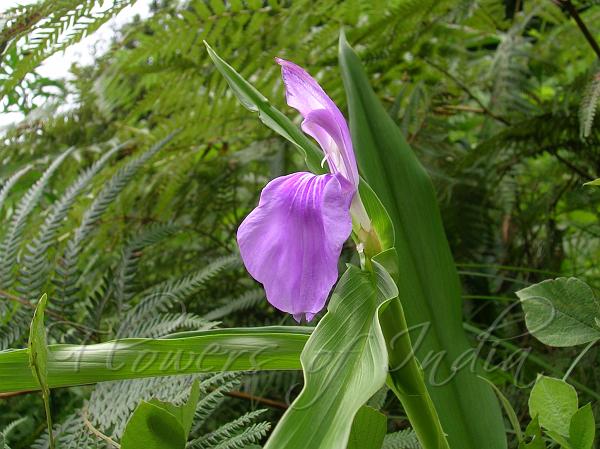
Botanical name: Roscoea purpurea Family: Zingiberaceae (Ginger family)
Synonyms: Roscoea purpurea f. alba, Roscoea purpurea var. gigantea
Synonyms: Roscoea purpurea f. alba, Roscoea purpurea var. gigantea
Kakoli Ginger is a stout perennial herb, 25-38
cm tall. This genus of plant is named in honour of William Roscoe,
the founder of the Liverpool Botanic Garden. Leaves are 4-8, elliptic,
lanceshaped to oblong-ovate, 14-20 cm long, sometimes sickle shaped,
tip tapering and sometimes slightly eared at base on lower leaves, side
veins parallel; leaf eared fringed with hairs. Flowers are borne in a
cluster at the top, the cluster-stalks enclosed in upper leaf sheaths,
only upper part of bracts and flowers visible. Flowers light purple,
mauve, lilac, pink or white with purple markings, usually only one or
two flower open at a time. Each flower has the typical structure for
Roscoea. There is a tube-shaped outer calyx. Next the three petals form
a tube slightly longer than the calyx, terminating in three lobes, an
upright hooded central lobe and two slightly smaller side lobes. Inside
the petals are structures formed from four sterile stamens
(staminodes): two lateral staminodes form what appear to be small
upright petals; two central staminodes are partially fused at the base
to form a lip. Lip is not deflexed, 4.5-6.5 x 2-5 cm. Kakoli Ginger is
found in the Himalayas, from Uttarakhand to Nepal, at
altitudes of 1520-3100 m. Flowering: June-September.
Medicinal uses: Traditionally, various parts like leaves, roots and flower etc. are
used for the treatment of diabetic, hypertension, diarrhea, fever,
inflammation etc. In Nepal tubers are boiled for edible purpose and also
used in traditional veterinary medicine.
Traditionally, various parts like leaves, roots and flower etc. are
used for the treatment of diabetic, hypertension, diarrhea, fever,
inflammation etc. In Nepal tubers are boiled for edible purpose and also
used in traditional veterinary medicine.
Medicinal uses:
Traditionally, various parts like leaves, roots and flower etc. are
used for the treatment of diabetic, hypertension, diarrhea, fever,
inflammation etc. In Nepal tubers are boiled for edible purpose and also
used in traditional veterinary medicine.
| Identification credit: Tabish | Photographed on Gobindghat-Ghangria route, Uttarakhand. |
• Is this flower misidentified? If yes,