
| Kadam |

|
 |

|


| File size | 687846 |
| Original date | 9/30/06 3:17 PM |
| Resolution | 2048 x 1536 |
| Flash | Flash did not fire, auto |
| Focal length | 5.4mm |
| Exposure time | 1/123s |
| Aperture | 2.8 |
| Focus Distance | |
| Metering Mode | Partial |
| Camera make | NIKON |
| Camera model | E3700 |
| Sensor type |
 |
 ative ative |
 |
 |
Photo: |
Botanical name: Neolamarckia cadamba Family: Rubiaceae (Coffee family)
Synonyms: Anthocephalus cadamba, Anthocephalus indicus
Synonyms: Anthocephalus cadamba, Anthocephalus indicus
 Kadam is a large, ornamental tree with a broad, umbrella-shaped crown that
can reach a height of 45 metres. Stem diameter is up to 100 cm but normally less;
sometimes with buttresses. The crown is
umbrellashaped and the branches are characteristically arranged in tiers.
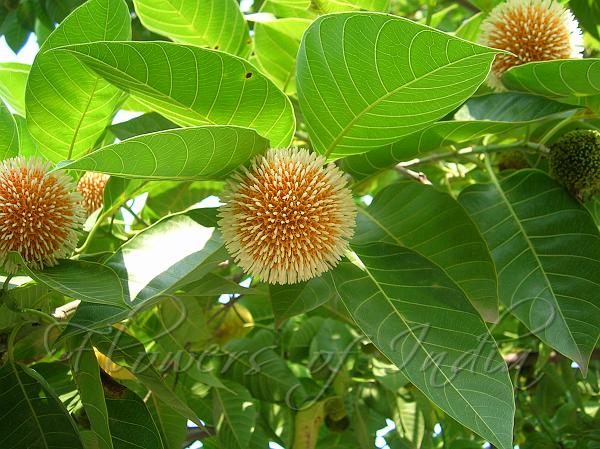
Leaves are simple, elliptic to oblong, 13-32 cm long. Flowers are orange, small,
borne in dense, spherical heads. They appear like solid, hairy orange balls.
The fruits are small capsules, packed closely together to form a fleshy,
yellow or orange coloured infructescence containing approx. 8,000 seeds.
A postal stamp was issued by the Indian Postal Department to commemorate
this tree.
Kadam is a large, ornamental tree with a broad, umbrella-shaped crown that
can reach a height of 45 metres. Stem diameter is up to 100 cm but normally less;
sometimes with buttresses. The crown is
umbrellashaped and the branches are characteristically arranged in tiers.
Leaves are simple, elliptic to oblong, 13-32 cm long. Flowers are orange, small,
borne in dense, spherical heads. They appear like solid, hairy orange balls.
The fruits are small capsules, packed closely together to form a fleshy,
yellow or orange coloured infructescence containing approx. 8,000 seeds.
A postal stamp was issued by the Indian Postal Department to commemorate
this tree.
Medicinal uses:
 In traditional folk medicine, different parts of Kadamba are utilized to treat a
range of issues like fever, uterine problems, blood disorders, skin conditions,
tumors, anemia, eye inflammation, and diarrhea.
In traditional folk medicine, different parts of Kadamba are utilized to treat a
range of issues like fever, uterine problems, blood disorders, skin conditions,
tumors, anemia, eye inflammation, and diarrhea.| Identification credit: Tabish | Photographed in Delhi & Imphal. |
• Is this flower misidentified? If yes,