
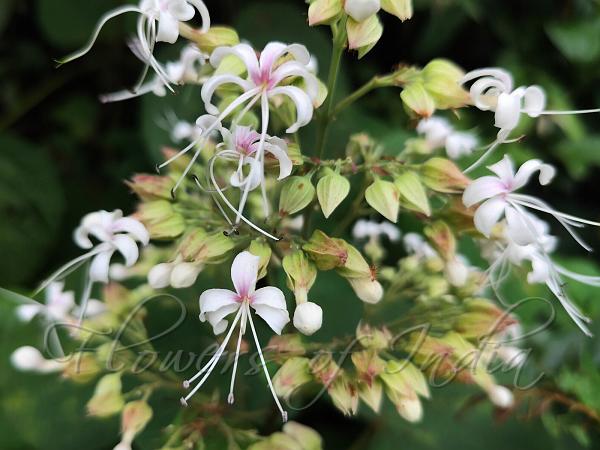
| Hill Glorybower |

|
 |

|


| File size | 403694 |
| Original date | 8/16/25 5:09 PM |
| Resolution | 1600 x 1200 |
| Flash | Flash did not fire, auto |
| Focal length | 6.19mm |
| Exposure time | 1/100s |
| Aperture | 1.65 |
| Focus Distance | |
| Metering Mode | Center weighted average |
| Camera make | Xiaomi |
| Camera model | 2312DRA50I |
| Sensor type | MonochromeArea |
 |
 ative ative |
 |
 |
Photo: |
Botanical name: Clerodendrum infortunatum Family: Verbenaceae (Verbena family)
Synonyms: Clerodendrum viscosum, Clerodendrum calycinum
Synonyms: Clerodendrum viscosum, Clerodendrum calycinum
Hill glorybower is a shrub with bark grey and corky; young shoots tawny
hairy. Leaves are 8-17 x 6-12 cm, ovate or round, base heart-shaped, margin
entire or finely toothed, tip tapering, hairy beneath and woolly above;
basally 5-7 nerved; leaf-stalk to 8 cm long. Flowers are borne in panicles
at branch-ends, 14-20 cm long, hairy. Bracts are leaf-like. Sepal-cup cup-shaped, 0.8-1 cm
long; sepals lanceshaped, 3-5-ribbed, tapering at tip, woolly. Flowers are
white, tubular; tube 1-1.5 cm long, hairy outside; petals 6-10 mm long,
oblong, hairy without. Stamens are 4, filaments slender, purplish, 2-2.5
cm long; anthers oblong. Ovary is spherical; style slender; protruding,
2-2.5 cm long. Drupe is 6-8 mm across, spherical, bluish-black on ripening;
fruiting sepal-cup enlarged, pink. Seeds are 2-4, spherical, 2-3 mm across.
Flowering: August-September.
Medicinal uses: Extract of the leaves is given orally in fever
and bowel troubles in the Kuki and Rongmei tribes in the North-East
India. Fresh leaf-juice is introduced in the rectum for removal of
ascarids. Leaves and flowers are used to cure scorpion sting.
Extract of the leaves is given orally in fever
and bowel troubles in the Kuki and Rongmei tribes in the North-East
India. Fresh leaf-juice is introduced in the rectum for removal of
ascarids. Leaves and flowers are used to cure scorpion sting.
Medicinal uses:
Extract of the leaves is given orally in fever
and bowel troubles in the Kuki and Rongmei tribes in the North-East
India. Fresh leaf-juice is introduced in the rectum for removal of
ascarids. Leaves and flowers are used to cure scorpion sting.| Identification credit: Tabish | Photographed in Goa, Dharmanagar, Tripura & Lucknow, UP. |
• Is this flower misidentified? If yes,