
| Guinea Grass |

|
 |

|


| File size | 1489779 |
| Original date | 9/18/25 9:28 AM |
| Resolution | 320 x 240 |
| Flash | Flash did not fire, auto |
| Focal length | 5.56mm |
| Exposure time | 1/804s |
| Aperture | 1.8 |
| Focus Distance | |
| Metering Mode | Center weighted average |
| Camera make | motorola |
| Camera model | moto g84 5G |
| Sensor type | MonochromeArea |
 |
 aturalized aturalized |
 |
 |
 |
Photo: |
Botanical name: Megathyrsus maximus Family: Poaceae (Grass family)
Synonyms: Panicum maximum, Urochloa maxima, Panicum laeve
Synonyms: Panicum maximum, Urochloa maxima, Panicum laeve
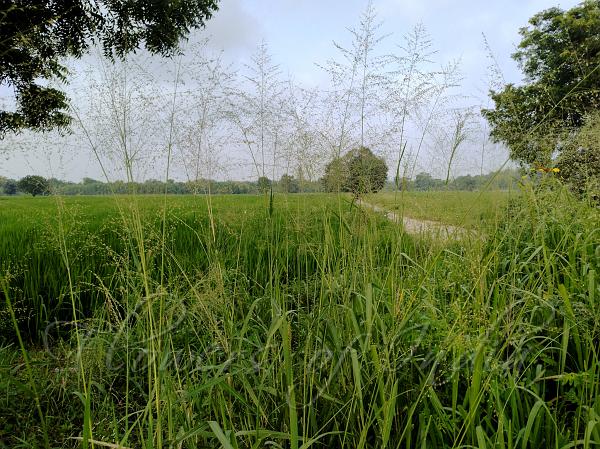
Guinea grass is a densely clustered perennial grass
with stems 0.8-3 m tall, erect or rising up, often branched, the nodes
usually bearded. Leaf-blades are linear, 10-60 cm long, 0.4-2 cm wide,
flat, hairless, long-tapering to a fine point; lowermost sheaths
strongly compressed and keeled. Flower panicles are ovate, 10-45 cm
long, contracted or open, the branches mostly bare in the lower half,
the lowermost prominently whorled. Spikelets are oblong, 2.5-3.6 mm
long, hairless or shortly and densely velvet-hairy, pointed or
subblunt; lower glume round, hyaline, a quarter to a third the length
of the spikelet, rounded or shortly pointed, 1-3-nerved or sometimes
almost nerveless; upper glume 5-7-nerved; lower lemma 5-7-nerved, its
palea almost as long; upper lemma pallid, rugulose. Guinea grass is
native to Tropical & S. Africa. It was introduced in India as a fodder
grass, and is now naturalized. It is also found in East Himalaya.
Flowering: June-October.
Medicinal uses: Guinea grass is used in the
treatment of heartburn and tympanitis. Sap from the crushed fresh plant
is used as a cicatrisant on wounds and sores. The grass is tied around
the head in order to bring relief from a headache.
Guinea grass is used in the
treatment of heartburn and tympanitis. Sap from the crushed fresh plant
is used as a cicatrisant on wounds and sores. The grass is tied around
the head in order to bring relief from a headache.
Medicinal uses:
Guinea grass is used in the
treatment of heartburn and tympanitis. Sap from the crushed fresh plant
is used as a cicatrisant on wounds and sores. The grass is tied around
the head in order to bring relief from a headache. | Identification credit: Shahid Nawaz, Chintan Bhatt | Photographed in Vadodara, Gujarat. |
• Is this flower misidentified? If yes,