
| Frilly Scaly-Ball |

|
 |

|


 |
 ative ative |
 |
 |
Photo: |
Botanical name: Lepidagathis trinervis Family: Acanthaceae (Acanthus family)
Synonyms: Barleria axillaris, Lepidagathis axillaris, Ruellia trinervis
Synonyms: Barleria axillaris, Lepidagathis axillaris, Ruellia trinervis
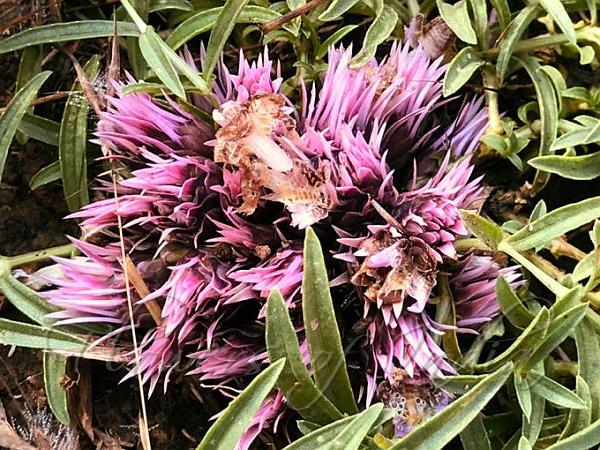
Frilly Scaly-Ball is a prostrate to suberect undershrub
reaching up to a foot tall, arising from a woody rootstock. Its twigs
are quadrangular, either bristly or hairless. Leaves are stalkless,
linear to narrowly lance-shaped, 2–4.5 cm long and 3–5 mm broad,
hairless, and distinctly 3-nerved from the base; the lateral nerves
are weaker than the midrib and run along the entire margin. Flowers are
light pink, arranged in dense, one-sided, stalkless, oblong-ovoid spikes
1–2 cm long, borne in leaf axils. These spikes are often fascicled near
the rootstock or slightly above. The frilly appearance of the flowers
is due to long, spine-tipped bracts, which are ovate or elliptic-ovate,
4–5 × 2.5–3 mm, with a recurved spine 3.5–4.5 mm long. Bracteoles
are nearly as long as the bracts. Sepals are 5, 7–8 mm long. Flowers
are 5–6 mm long, and capsules are 5–6 mm long, 2-seeded.
Frilly Scaly-Ball is found in East Himalayas and from
Bihar to central, western and southern India. Flowering: September-February.
Medicinal uses: The plant is used as a bitter tonic. It is used
for rheumatic affections.
The plant is used as a bitter tonic. It is used
for rheumatic affections.
Medicinal uses:
The plant is used as a bitter tonic. It is used
for rheumatic affections. | Identification credit: Prashant Awale, Sushant More | Photographed in Navi Mumbai, Maharashtra. |
• Is this flower misidentified? If yes,