
| Eastern Glorybower |

|
 |

|
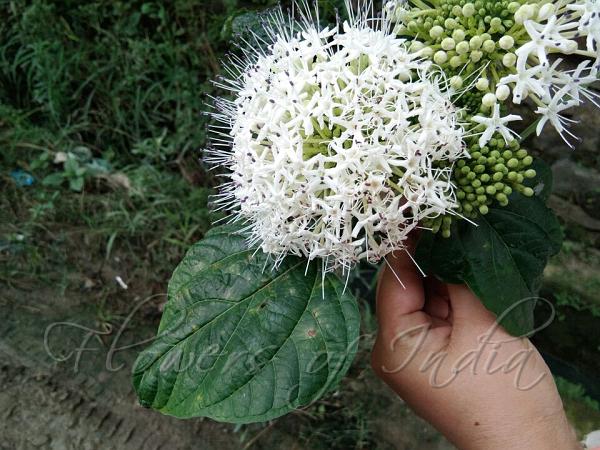


 |
 ative ative |
 |
 |
Photo: |
Botanical name: Clerodendrum colebrookeanum Family: Verbenaceae (Verbena family)
Synonyms: Clerodendrum ixoriflorum, Clerodendrum glandulosum
Synonyms: Clerodendrum ixoriflorum, Clerodendrum glandulosum
Eastern glorybower is a shrub or small tree,
1.5-3 m tall. Branchlets are robust, 4-angled, densely yellow-brown
finely velvet-hairy when young. Leaf stalks are 2-20 cm long, carrying
broadly ovate to elliptic- heart-shaped leaves which are 7-17 cm long,
6-21 cm wide. Leaf base is wedge- shaped to heart-shaped, margin
entire to slightly wavy, tip long-pointed to pointed. Flowers are
borne in 4-6-branched corymbose cymes, at the end of branches. Stalk
carrying the cyme is robust, 1.5-13 cm. Bracts are lanceshaped, 1.5
cm, deciduous. Sepal cup is bell-shaped, 3-5 mm, tube 1-3 mm, densely
velvety, with several peltate glands. Sepals are triangular, less than 1
mm. Flowers are white or rarely pinkish, with a long narrow tube 1.2-2.5
cm. Petals are oblong, 3-6 mm. Stamens and style prominently protrude
out. Fruiting sepal cup is purple, inflated. Fruit is blue-green,
becoming black when dry, nearly round, about 1 cm in diameter. Kuki
people of Manipur cook pork with the leaves of this plant.
Eastern glorybower is found in NE India, and parts of China and SE Asia,
at altitudes of 500-2000 m. Flowering: August-December.
| Identification credit: Prashant Awale | Photographed in Imphal, Manipur & Ailong, Mizoram. |
• Is this flower misidentified? If yes,