
| Clove |

|
 |

|


 |
 ntroduced ntroduced |
 |
 |
 |
Photo: |
Botanical name: Syzygium aromaticum Family: Myrtaceae (Bottlebrush family)
Synonyms: Caryophyllus aromaticus, Eugenia caryophyllata
Synonyms: Caryophyllus aromaticus, Eugenia caryophyllata
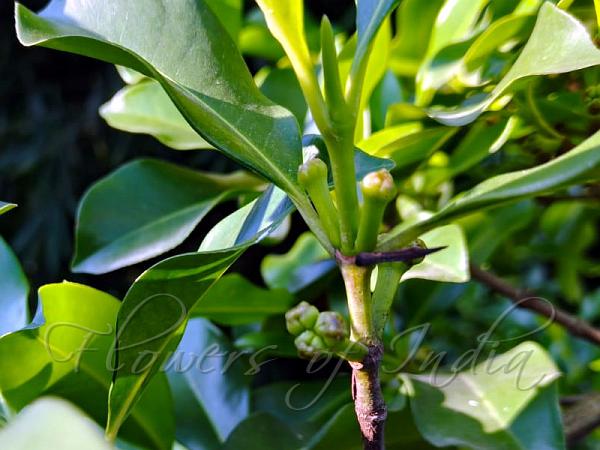
Cloves are the aromatic flower buds of a tree, native
to the Maluku Islands, or Moluccas, in Indonesia. The clove tree is an
evergreen that grows up to 8-12 m tall, with large leaves and crimson
flowers grouped in at branch-ends clusters. The flower buds initially
have a pale hue, gradually turn green, then transition to a bright red
when ready for harvest. Cloves are harvested at 1.5-2 cm long, and
consist of a long sepal-cup that terminates in four spreading sepals,
and four unopened petals that form a small central ball. Clove stalks
are slender stems of the inflorescence axis that show opposite
decussate branching. Externally, they are brownish, rough, and
irregularly wrinkled longitudinally with short fracture and dry, woody
texture. Mother cloves (anthophylli) are the ripe fruits of cloves that
are ovoid, brown berries, unilocular and one-seeded. Blown cloves are
expanded flowers from which both flowere and stamens have been
detached. Exhausted cloves, also known as used cloves, have most or all
the oil removed by distillation. Clove are extensively used in cooking.
| Identification credit: Thingnam Girija | Photographed in cultivation in Manipur. |
• Is this flower misidentified? If yes,