
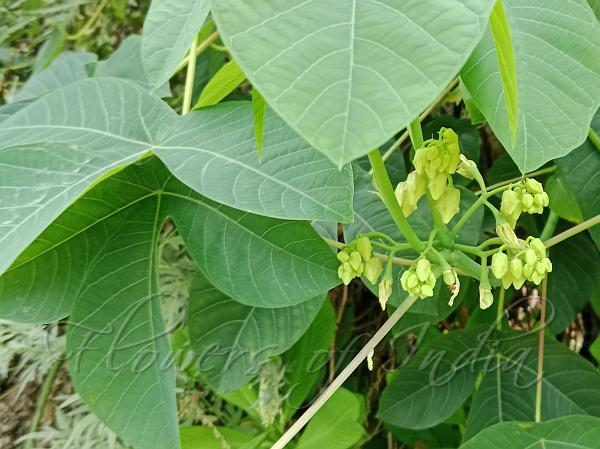
| Ceara Rubber Tree |

|
 |

|


| File size | 580389 |
| Original date | 6/2/26 4:47 PM |
| Resolution | 2048 x 1536 |
| Flash | Flash did not fire, auto |
| Focal length | 4.04mm |
| Exposure time | 1/49s |
| Aperture | 1.8 |
| Focus Distance | |
| Metering Mode | Center weighted average |
| Camera make | vivo |
| Camera model | vivo Y22 |
| Sensor type | OneChipColorArea |
 |
 ntroduced ntroduced |
 |
 |
 |
Photo: |
Botanical name: Manihot glaziovii Family: Euphorbiaceae (Castor family)
Synonyms: Manihot carthagenensis subsp. glaziovii
Synonyms: Manihot carthagenensis subsp. glaziovii
Ceara Rubber Tree is a tree or shrub, up to 14 m tall;
bark strongly peeling glossy brown, latex abundant; branches
herbaceous, hairless. Stipules are lanceshaped, 4-6 mm, gray-green,
jagged; leaf-stalk 4-25 cm, with many longitudinal grooves, peltate,
inserted at least 5 mm from margin. Leaves are palmately 3-7-lobed,
10-30 x 15-25 cm, papery or membranous, lobes obovate, elliptic,
rhomboid, or spoon-shaped, 7-10 x 3.5-7 cm, margins entire, tip pointed
to shortly tapering. Flowers are borne in panicles 7-9 cm; bracts
lanceshaped, about 2.5 mm. Male flowers: sepal-cup 9-11 mm, 5-lobed,
sepals oblong, about 5 × 2-3 mm, tip blunt, hairless inside; disk
shallowly cup-shaped, 10-lobed, hairless; anthers oblong, about 2.5 mm.
Female flowers: sepal-cup 10-11 mm, 5-lobed; ovary ellipsoidal,
hairless. Capsules are spherical or nearly so, about 2 cm in diameter,
warty, wingless, wrinkled.
Leaves are eaten as a vegetable. The leaves contain hydrocyanic acid,
which is toxic, but it is destroyed by heat and so the cooked leaves
are safe to eat. Root is a famine food, it is eaten in times of food
scarcity. The root is rich in starch but it is hard and woody. Ceara
Rubber Tree is native to NE Brazil, cultivated in South India.
Flowering: September-October.
| Identification credit: Manikandan M., Kiranraj R. | Photographed in Nilgiris district, Tamil Nadu. |
• Is this flower misidentified? If yes,