
| Asian Bushbeech |

|
 |

|


| File size | 3696722 |
| Original date | 5/14/08 2:04 PM |
| Resolution | 3264 x 2448 |
| Flash | Flash did not fire, auto |
| Focal length | 82.8mm |
| Exposure time | 1/320s |
| Aperture | 5.6 |
| Focus Distance | |
| Metering Mode | Multi-segment |
| Camera make | Panasonic |
| Camera model | DMC-FZ18 |
| Sensor type | OneChipColorArea |
 |
 ative ative |
 |
 |
 |
Photo: |
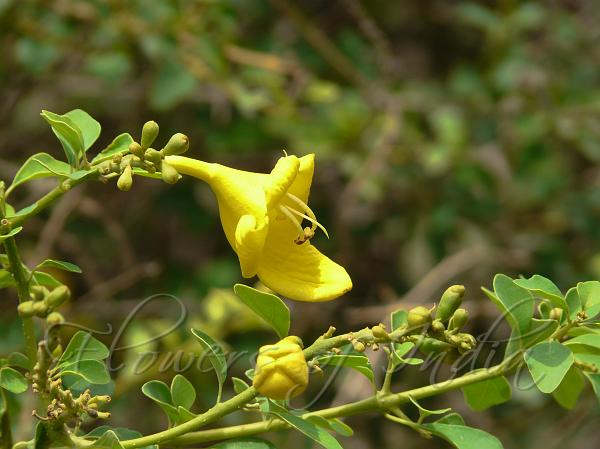
Botanical name: Gmelina asiatica Family: Verbenaceae (Verbena family)
Synonyms: Gmelina parvifolia
Synonyms: Gmelina parvifolia
Asian Bushbeech large straggling or scrambling deciduous bush or shrub, rather hardy, to
about 3 m tall, or rarely a semi-evergreen tree to 8 m tall, sometimes
prostrate, usually spiny, sometimes unarmed, much-branched, very variable
in size and habit; bark yellowish- or brownish-white, thin, smooth; wood
hard, grey; branchlets horizontal, rigid, often compressed. Leaves are
small. Leaf stalks 0.5-3 cm long, slender. Leaf-blades varying from oval or
ovate to elliptic, obovate, somewhat rhomboid, or triangular in outline, very
variable, mostly 1-9.5 (rarely up to 13) cm long, 1.5-6 cm wide, entire or 3-5
lobed when young. Flowers are large, borne in short cymules in mostly
racemelike panicles 2.5-5 cm long. Flowers are yellow or bright
sulphur-yellow, 4-5 cm long, curved bell-shaped. Asian Bushbeech is found
in India to SE Asia.
| Identification credit: Tabish | Photographed at Qutub Minar, Delhi. |
• Is this flower misidentified? If yes,