
| Arrowleaf Glorybower |

|
 |

|


| File size | 566906 |
| Original date | 6/28/25 4:26 PM |
| Resolution | 1760 x 1320 |
| Flash | Flash did not fire, auto |
| Focal length | 6.19mm |
| Exposure time | 1/50s |
| Aperture | 1.65 |
| Focus Distance | |
| Metering Mode | Center weighted average |
| Camera make | Xiaomi |
| Camera model | 2312DRA50I |
| Sensor type | MonochromeArea |
 |
 ative ative |
 |
 |
 |
Photo: |
Botanical name: Clerodendrum hastatum Family: Verbenaceae (Verbena family)
Synonyms: Siphonanthus hastatus
Synonyms: Siphonanthus hastatus
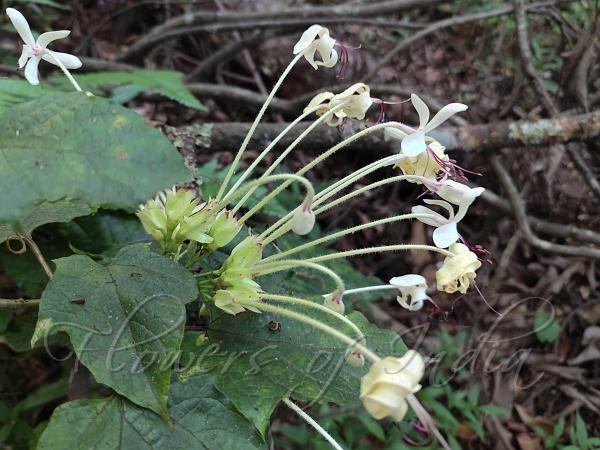
Arrowleaf glorybower is a large shrub with long,
graceful, long-tube white flowers. Flower tube is 10-15 cm long, 2.5 cm
across, hairy outside, inflated from points of insertion of filaments.
Petals are 2.5-4 x 0.5-0.6 cm. Filaments purple on the exposed half,
white in the portion inside the flower tube. Sepal-cup about 2.5 cm
long, dull greenish white, divided nearly to the base; sepals up to 1.5
cm long, ovate-oblong, pointed. Flowers are borne in dense broad
corymbs at branch-ends panicles; bracts linear, about - 6 in long.
Leaves are 8-26 x 6-20 cm, opposite, often in very unequal pairs,
arrow-shaped, ovate or oblong, lobed or angled, pointed or tapering,
membranous, rough above, softly hairy beneath, specially along the
nerves, often purplish beneath; base shallow heart-shaped or hastate;
lateral nerves 4-6 on either half, 2 lower from the base; leaf-stalk
1-5.5 in long. Drupe is purplish black, fleshy, 0.7-1.2 cm across,
seated on the much enlarged red sepal-cup. Arrowleaf glorybower is
found in NE India. Flowering: May-November.
Medicinal uses: In Arunachal Pradesh, the Tangsa
community uses it as a medicinal plant. They make a leaf paste with water
that’s collected in holes of timber, which is then applied externally
to areas of the body that have turned blue from accidental bumps. This
helps to ease pain and clear out the accumulated blood.
In Arunachal Pradesh, the Tangsa
community uses it as a medicinal plant. They make a leaf paste with water
that’s collected in holes of timber, which is then applied externally
to areas of the body that have turned blue from accidental bumps. This
helps to ease pain and clear out the accumulated blood.
Medicinal uses:
In Arunachal Pradesh, the Tangsa
community uses it as a medicinal plant. They make a leaf paste with water
that’s collected in holes of timber, which is then applied externally
to areas of the body that have turned blue from accidental bumps. This
helps to ease pain and clear out the accumulated blood.
| Identification credit: Tabish | Photographed in Meghalaya. |
• Is this flower misidentified? If yes,